An Opinionated Guide to New York City
A map turning subjective human experiences into concise and trustworthy ways of discovering urban space.
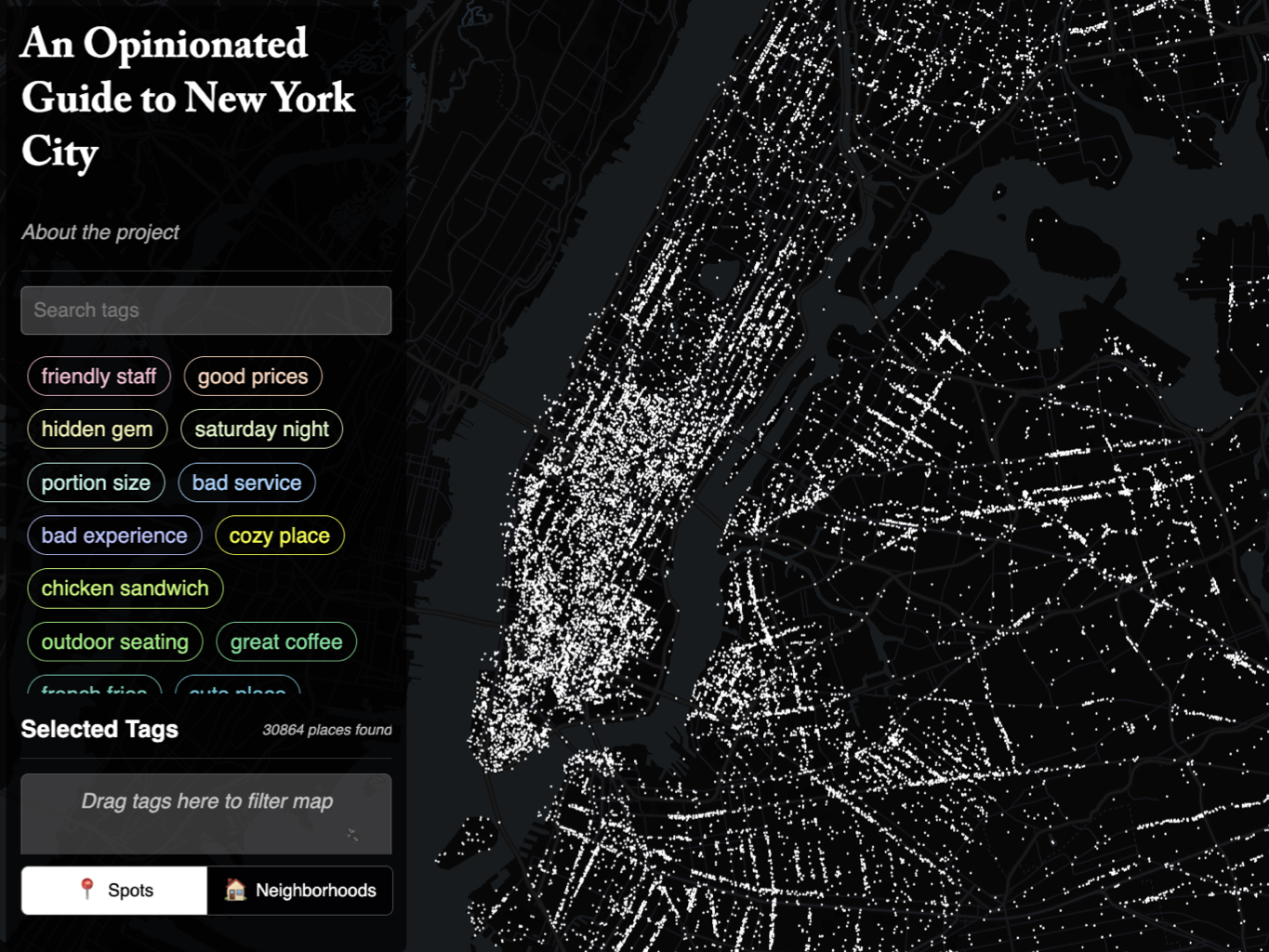
Can we capture a place’s character and collective memory in a single quote, distilled from the voices of its visitors?
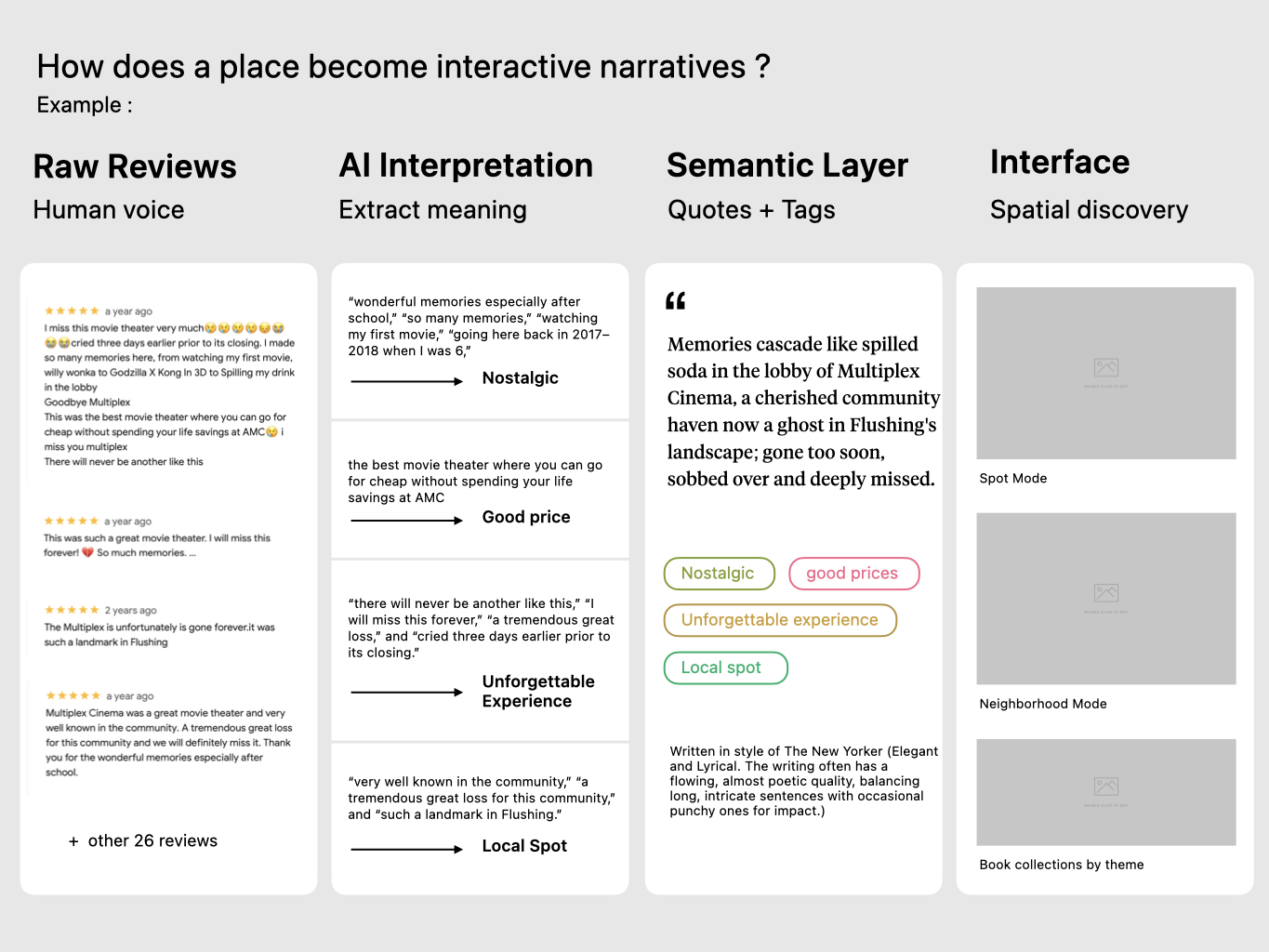
I used semantic similarity models to transform reviews into evocative and poetic place stories and 262 semantic tags, revealing NYC’s local character, atmosphere, and collective memories.
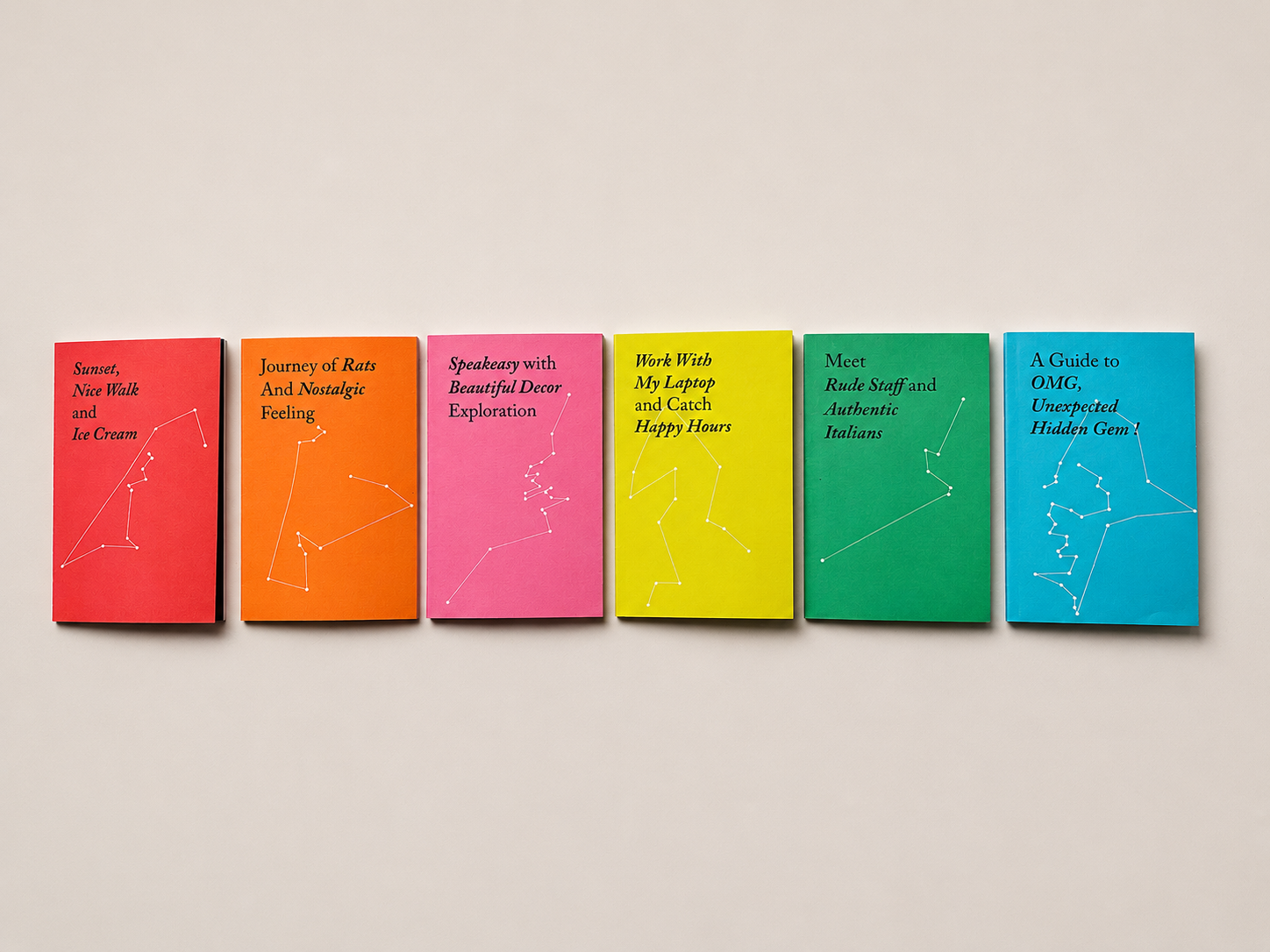
An Opinionated Guide to NYC explores how AI can turn human reviews in Google Map into a new way of reading the city. Through generated narratives, a system of 262 semantic tags, and map interfaces, the project surfaces local stories, collective memories, and perspectives that conventional maps often overlook.
Challenge
Traditional maps prioritize distance, ratings, and popularity, but reveal little about what makes a place meaningful. Public reviews (in this project, Google Review) contain richer but fragmented experiences, include emotions, memories, and sometimes conflicting opinions. I hope people can read the map like reading a novel, and that come up with the design question: How might we distill these voices into navigable stories with local insights and emotions?
Solution
A semantic system designed to transforms 30 reviews per place into evocative narrative quotes, using literary-inspired editorial rules to capture its character, atmosphere, and collective memories. In parallel, I used semantic similarity models to cluster recurring expressions into 262 distinct tags, revealing patterns and characteristics across NYC neighborhoods.
The project features four interfaces for exploring the city through collective stories and semantic insights.
Spots Mode: Discover places in New York City through AI-generated stories and semantic tag filters.
Neighborhood Mode: Explore and compare the defining sentiments, characteristics and ranking of NYC’s 350 neighborhoods.
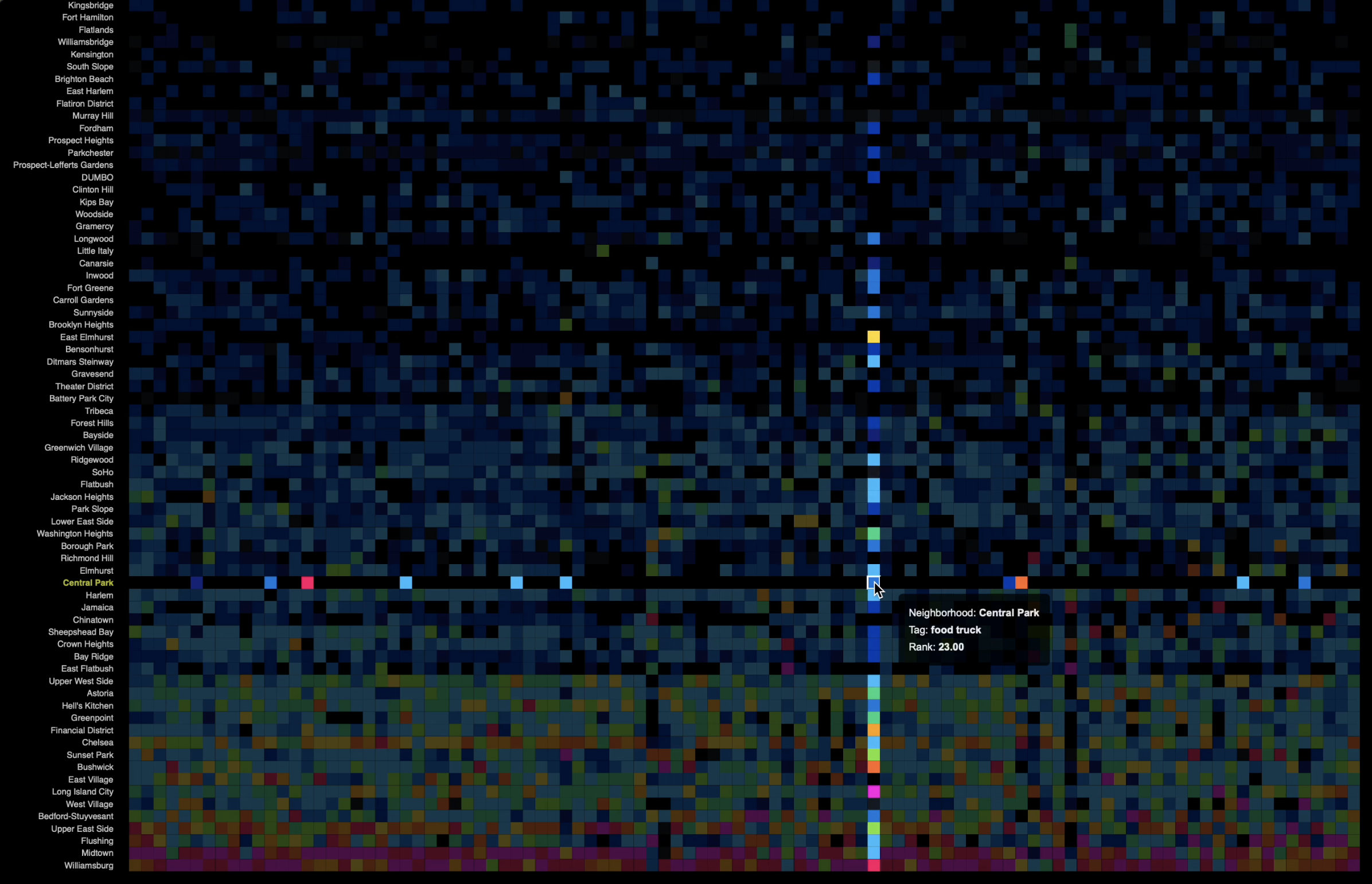
Neighborhood Matrix: Visualize how 100 common keywords relate to 350 neighborhoods, revealing patterns in local sentiment and identity.
Guide Book: Create themed collections of places based on selected semantic tags, complete with stories and locations.
Learning
How do we make AI-generated stories both reliable and engaging?
AI needs consistency in what it means, but flexibility in how it expresses it. A single review may not represent a place, while overly controlled AI writing can make every place sound like commercial promotion. Evaluating 1,000 places showed that AI-generated stories had more consistent semantic alignment with the original reviews, though slightly lower average similarity than individual reviews. I chose a moderate creativity setting (temperature = 0.7) with clear editorial guidelines, giving AI freedom in expression while keeping the core meaning consistent, so each place can tell its own distinctive story.
Can everyday language reveal meaningful patterns that traditional maps overlook?
Ratings and categories rarely capture qualities like nostalgia or local character. But before turning these expressions into navigation tools, I needed to test whether they represented meaningful patterns. Semantic clustering grouped related phrases far more closely than random assignments (0.77 vs. 0.20). Spatial analysis also revealed that some tags, like “hidden gem,” formed geographic clusters, while others, like “pet friendly,” were more evenly distributed. I used shared semantic tags for place discovery and normalized neighborhood profiles for comparison, recognizing that not every theme defines a neighborhood’s identity.
Vision
Finding patterns in data is only the beginning. Good design determines which patterns are meaningful, and how people can use them in various scenario. I envision a spatial companion that understands personal interests, suggests unexpected places through language and context, and bringing curiosity and serendipity back into everyday discovery.